
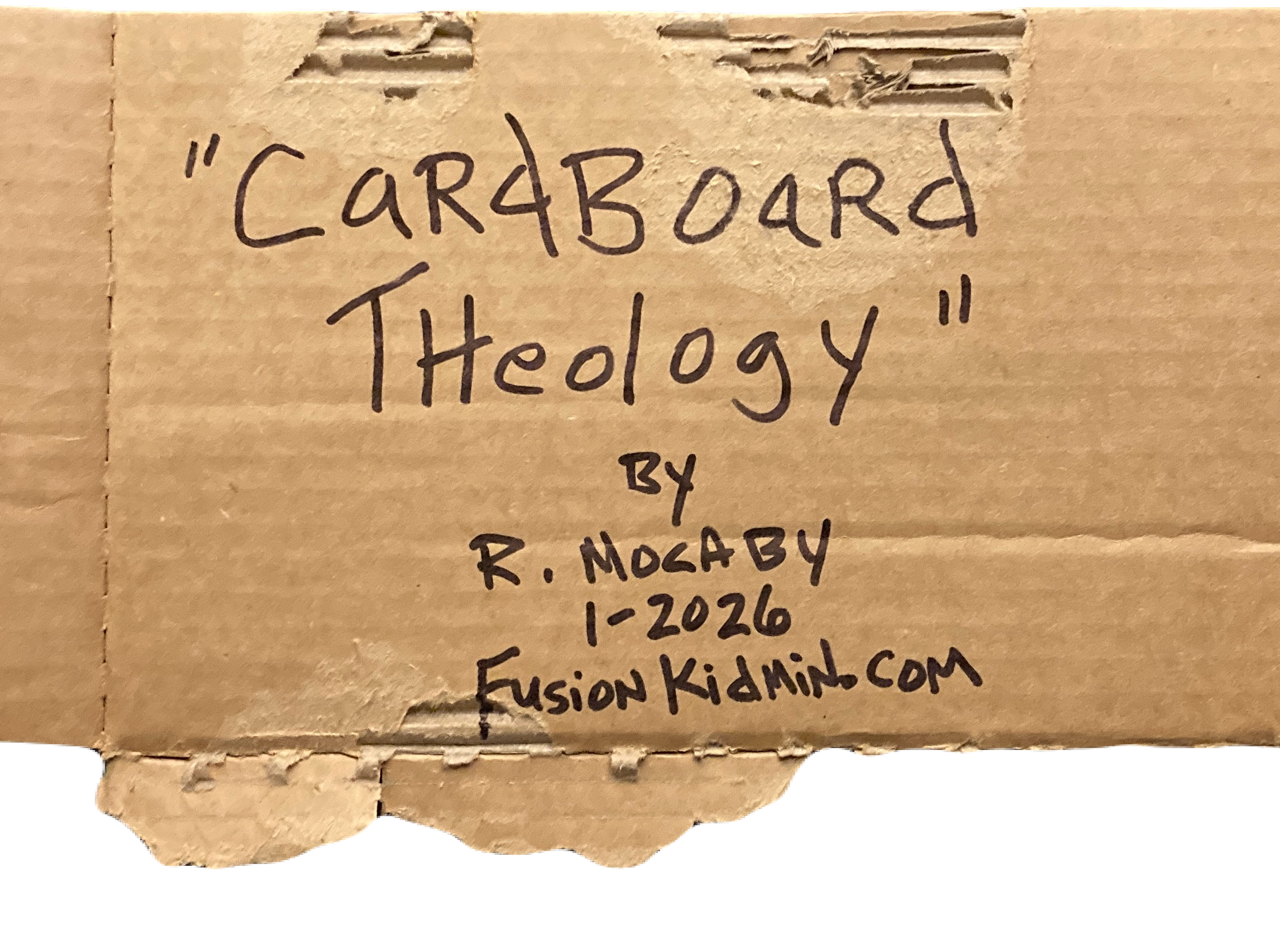
Kids Ministry (KidMin) is at the crossroads when it finds itself guilty of embracing optics over obedience and its production outpaces Presence because creativity was no longer required.
Maybe it’s time to go back to the Cardboard.
KidMin today stands at an important crossroads. In many mega and neo-church environments, children’s church increasingly mirrors adult worship experiences—complete with LED walls, moving lights, haze machines, click-tracks, and tightly choreographed production cues. While excellence and intentionality are not inherently wrong, a serious biblical and moral question deserves to be asked:
Have we traded God-given creativity for technological dependency—and in doing so, dulled the very formation we’re called to steward?
So … are we losing touch of real “stewardship” by foregoing our natural intuition to monitor and guide us, as the Spirit guides us in exchange for automational devices?
Stewardship is my focal point of this article, not the bashing of technological toys in kids church.
Well, let’s bash the technological toys momentarily for the sake of getting your attention. If anything, you might regain a fresh and renewed true vision of the mission if only I can toss your LED screens, lights and smoke machines to the curb to give you cause to work with what you first started with anyway. You’re familiar with what I’m saying; when cardboard, pieces of scrap wood, magic markers and duct tape was your primary source of prop production (for many, it still is).
Many of us grew up inventing play with nothing more than sticks and dirt. That kind of upbringing forged a uniquely creative generation—where having little to no resources forced us to imagine, adapt, and create something out of nothing. It was in those conditions that our creativity was not just encouraged, but required.
That’s the very danger, subliminally, devouring us today … “creativity, not required”.
Back then, play time was invented, not provided.
I was the poor kid living in the projects where imagination had to do all the heavy lifting. Little did I know, that was the breeding ground for genuine creativity.
In 1977, while your parents were buying you that new Kenner Millennial Falcon from the store shelf and all those action figures to boot, I was overflowing with joy to have bought some used second-hand knock-off Hot Wheels cars and 9 green plastic army soldiers in a sandwich baggie at a yard sale.
I was forced to create out of scarcity and didn’t even realize it. That Section 8 environment didn’t limit creativity, it demanded it; forging my mind to create something out of nothing.
That almost sounds like a Divine Trait that was meant to be in us all anyway.
I’m immediately recognizing that totally relying on AI and overnight Amazon orders can rapidly delete our creative thinking process, that God inherently empowered us with, not to mention that those things force you on a swift exit of scriptural dependence.
Am I criticizing AI and Amazon conveniences? Only when they’re mishandled—because powerful tools, used carelessly or with an overreliance, can wound rather than help. The issue isn’t access to resources; it’s dependence on them. When modern marvels begin doing the heavy lifting of ministry, they can subtly strip away genuine passion and replace it with spiritual passiveness.
Remember the phrase, “Back to the drawing board”? That’s the narrative here. Let’s get back to the cardboard, at least in a spiritual parallel and mental capacity for starters. Exercise your creativity before it becomes disabled.
As we scan over some Biblical foundations, we will discover that God works through people, not platforms!
• God used a staff, not a lighting rig, in Moses’ hand.
• Jesus taught children with stories, dirt, bread, fish, directed attention to the fox and birds but not with spectacle.
• The early church discipled through homes, meals, songs, and shared life, not staged experiences.
The biblical pattern is clear: God delights in availability, not amplification. We always seem to arrive at a point where we forget that the simplicity of the Gospel is powerful enough within itself.
When KidMin becomes overly reliant on production, the subtle message communicated to children is that impact comes from equipment, not obedience; from systems, not surrender.
Formation vs. Stimulation. WOW! There’s a thought! Are we stimulating our kids in ministry or forming them?
*awkward yet valuable moment of pause
*Resume play
Children are not miniature adults—and discipleship is not entertainment. Did I just say, “The use of props and costumes while teaching children’s Bible stories is a method from Hell!”?
No, I did not. However, the reliance on that a costume will bring conviction, is the mask that does need removed. Animations won’t call down the Anointing.
High-stimulus environments with screens, decorated walls, jumbo props, projectors, light FX, etc. are great! I have implemented these tools and they do perform when executed properly. But know this, these things:
• Hold attention temporarily
• Create emotional highs
• Compete with secular media
If you have an over reliance on this stuff, you will need to be aware, they often struggle to:
• Build spiritual resilience
• Foster imagination rooted in Scripture
• Teach reverence, stillness, and wonder
As you build your children’s church environment with modern spectacles, do not build it with the intentions that these are the logs for a revival. We go to these extents simply because we can, it’s attractive and actually desired by many families seeking a fun and enthusiastic kids church. But I can promise they won’t be on Heavens checklist.
As King Solomon built the most elaborate Temple for the Lord with the finest of everything he could get his hands on. I’m 100% with the mindset that we should create the absolute best kids church in town, including all those bells and whistles(if so desired) but our passion must not be contained within the eye candy and that’s where the danger awaits. There’s a bait and switch that can happen swift and subtle within our earnest motives.
Every piece of equipment or prop should be purposefully initiated to magnify the Kingdom or God.
Go in knowing that the “WOW Factor” is a temporal effect and should never carry the weight of your calling. When every moment must “wow,” children may never learn how to sit with a story, wrestle with the truth or worse yet, engage their own creativity.
In contrast, low-tech, hands-on ministry invites children to participate, not just consume. There’s the key! Participate vs Consume. LED lights or not, are your children participating within your ministry or are they just sitting back consuming your clown acts?
If that’s not thought provoking enough … then buckle up, Buttercup! The following is full of sharp curves and I ain’t slowing down.
There is something profoundly biblical about cardboard, crayons, glue, and imagination for it all ties in to the human creativity that our Maker has installed within us to utilize.
Remember when we made puppets out of small brown paper bags and mimicked a bible lesson with them? When’s the last time you’ve even heard of that? Today, if there isn’t a professionally made full-body, third-hand, felt puppet behind a four-tier puppet stage glowing under a black light presentation, then we ain’t going.
Handmade props, simple object lessons, and creative storytelling are becoming a lost art to those dependent upon near instant professional props and production. When people (including children) see handmade props they absorb the true creativity that was used in its making. Creativity is truly recognized and appreciated. People observe and follow creativity.
The use of your homemade Sunday School material can accomplish the following:
• Affirm that God works through ordinary things
• Invite children to create, not just observe
• Model stewardship over spectacle
Did you catch that last one about stewardship? Stewardship of your God-given creativity, whether it be great or small.
Grasp hold of this next one … ready?
When a teacher builds a prop by hand, children learn:
“God can use what I have, not just what I buy.”
*Another awkward yet valuable pause.
*Resume play.
Children can’t buy stuff like adults can.
They sense the difference of value and importance between things we buy and things we make. This is why VBS tends to remain very powerful … the majority of the optics were truly hand-made for the occasion.
AHH! The lights are coming on and glowing bright in that head of yours, isn’t it?
This mirrors God’s economy—where five loaves matter more than flawless presentation.
The disciples looked for a source to BUY food in order to supply the need while simultaneously blatantly overlooking what they had at their disposal … loaves and fishes.
As I wind this thing down, let’s have a moment of moral reflection: What are we training our children to expect?
If children only encounter God in environments saturated with screens, soundtracks and special FX … what happens when those elements are gone?
Will they still pray without music, read scriptures without visuals or even trust God without those emotional cues?
Ministry that depends on production risks producing dependence, not discipleship.
Allow me to repeat myself from what I said in the beginning; This is not anti-technology - it is pro-formation.
Technology is a tool, not a theology.
The concern is not use - but overuse.
Not excellence - but replacement.
Personally, I will always use costumes, puppets, props, visuals, media … ALL of it! But I must take ownership and stewardship in my calling and recognize the dangers that when technology replaces my creativity, substitutes my relationship with God and family or distract me from scripture, then it’s time to pull the reins.
This Cardboard Theology is a call to rebalance.
Perhaps KidMin needs not a shutdown of technology, but a return to intention so that the lights support the message, not become it. Let creativity come from people before the platforms and finally, let children see adults trust God more than all that gear we pile up.
Because in the end, disciples are formed by presence, not production.
And cardboard - shaped by faith and imagination, may still preach louder than any screen ever could. Ya might want to consider going back to cardboard for a quarter season.
In the end … strip your kid ministry of all the “stuff”. Renew your creativity. Refresh your conductivity with biblical correlation. Get back on the true, Godly pace of children’s evangelism. As you slowly reincorporate all those technological toys, you just might find out that you can get by without some of it then reapply those finances or resources to something more profitable. But even more, you will regain the confidence that you didn’t realize you even lost.
R. Mocaby
FusionKidmin.com
Faith - Fun - Foundational
Jan. 2026